The Old Lady and the Television
Angeline Sibley walked from a limousine into a dark, empty house on Government Street in the summer of 1957, wheeling ahead a senile old woman in black with whom she shared no blood. At that moment she was sure of precious little — perhaps as little as when she’d first stepped off the southbound train in her twenties and walked out onto Beauregard Street.
Two days earlier, her husband, Clarence, had keeled over at home, right after supper and before the television news. He was the third person to die in the old Ladd place, now the old lady’s, and the sixth to be laid out in the front room. Dauphin Way Baptist pastors officiated the funeral, and members of Howard Lodge conducted the graveside at the only iron-fenced family plot in the Creola cemetery. He was 65.
Struck by an aortic aneurysm to instant death, he hadn’t the warning to direct Angeline toward any important records. She knew she was the sole beneficiary of his estate — they’d written reciprocal wills a few years back, each requiring the other to be notified by certified letter if either was changed. Clarence left her the house downtown, the shop, a dozen or two scattered rental properties, and his mother.
She knew Ophelia had been living on a trust. The Hatter family’s turpentine and lumber wealth funded the old lady’s life, but she was granted no principal. Muh’ Dear’s baby brother Lyles left her half the family estate in his will when he died ten years ago, but only in a lifetime trust. Her sister Edith was also to live off the trust, but for just ten years. Edith died in the 1930s, so her daughters in Chicago were due to inherit her portion of the corpus that year, per stirpes.
The subject of a longstanding family tiff predating their father’s own death, their sister Kate went unmentioned in Lyles’ will. Of the sisters, Kate had married first, and best. Frank Ladd had been a cotton factor with an office on Commerce Street close enough to smell the river and a short walk to inspect the bales that, by autumn, arrived daily on trains from Montgomery and Selma and by steamship from up the Alabama and the Tombigbee.
Kate’s house was a grand one. The second house west of Dexter Avenue, it occupied a double lot, stout and center, graced with room to preen. A deep front porch and balcony anchored its façade. Across the street, Blacksher Gardens attracted thousands of visitors daily when the azaleas and dogwoods bloomed. Boasting free admission, the gardens in the 1930s had attracted steady pedestrian and streetcar traffic, plus as many as 7,500 automobiles per day — three times the number eager to take the daytime excursion out to the newer and more expansive Bellingrath 30 miles from town.
By the time the Sibleys occupied the home, it was standing with by-then scattered architectural survivors out toward the Loop. The once-small Weinacker’s grocery, on the corner of Catherine, had become a modern shopping center, and a filling station had been built across from it. Perhaps the biggest letdown started just before Kate died, when Mrs. Blacksher across the street passed away. The Sibleys’ view bore the marks of the resulting neglect on the gardens for at least a year before the Blacksher house was leveled and piles of decades-old sasanquas, indicas and japonicas were cleared for a new 105-room motel. No brick had been laid yet but its developers had no interest in keeping up the historical gardens in the meantime.
Clarence was in line for at least a part if not all of Ophelia’s trust. Just how much Clarence had been due seems to have been open to legal interpretation. With him gone first, that answer now seemed largely dependent on Ophelia. They always expected the old lady to go first, so the thud when he hit the floor shook Angeline’s own foundation.
Angeline did know a few things: First, she had no obligation. She could have walked away from that dark old house, summoned the sister in New Orleans, and left Ophelia muttering inside. Further, she didn’t have an empty bank account, and she owned several properties — she could move back to St. Emanuel Street and continue life as a modest but comfortable landlady.
And finally, she technically owned the Government Street house. She didn’t need to decide today.
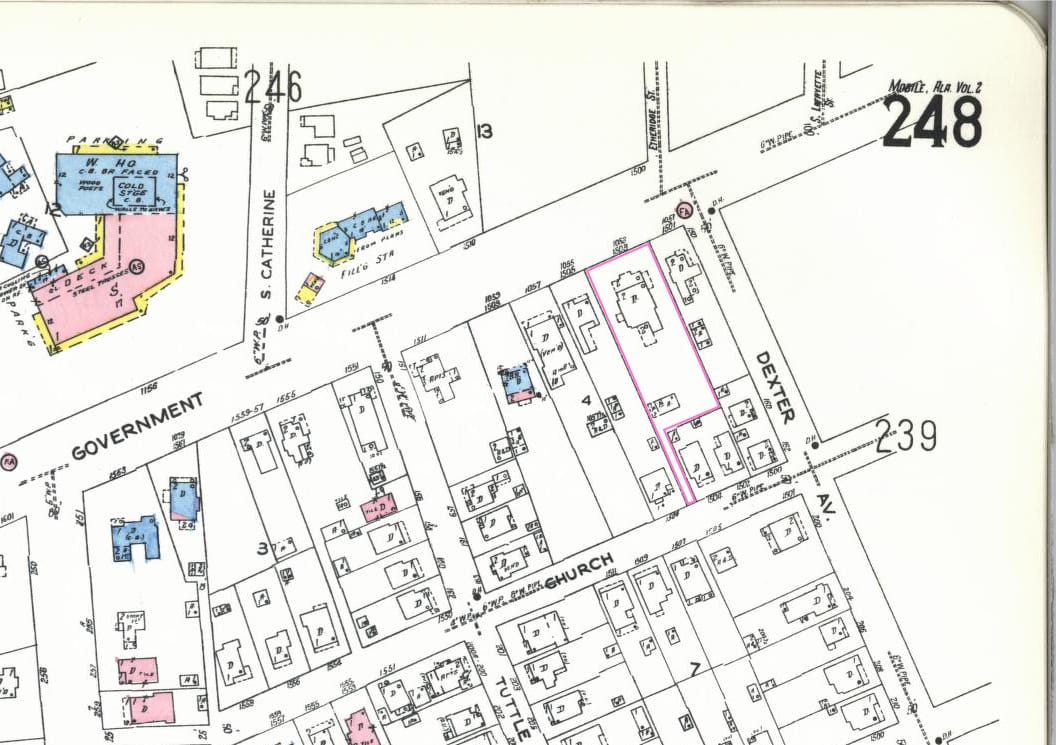
None of Kate’s children wanted her house after she died in ’55, so Ophelia and Clarence agreed to go in together. Ophelia’s own handsome home on North Lafayette Street was growing empty and creaky. She’d sold off antiques from the second floor in the late twenties, slowly liquidating and disregarding rooms that were increasingly difficult to reach and that she would never fill again. The flush Ladds, by contrast, had kept up Kate’s home and installed an elevator. Ophelia wanted it.
Ophelia deeded Clarence the Lafayette Street house for him to sell, and he bought the Ladd house. Clarence’s name alone was on the deed. He then paid $50,000, half in cash, the remainder to be paid at $5,000 annually at five percent interest. Angeline followed Son into that big house with Muh’ Dear. Clarence sold his mother’s house a couple of months later for $8,100.
Ophelia’s inaccessibility to the corpus of Lyles’ estate likely weighed on her fragile sanity. She’d been admitted on a few occasions to Bryce Hospital, and elsewhere documented a conditional acceptance of reality. Her marital home had been on the sawmill property at Hatter’s Pond, where her three children were born. The 1902 city directory listed her in a house down the bay as Mrs. Ophelia Sibley, widow of Robert.
Only Robert wasn’t dead. She divorced Clarence’s father, a railroad engineer, at the turn of the twentieth century and moved the children to Mobile to become a renter, cultivating the air of a dowager with none of the means.
Conversely, relatives recall the staff at the Government Street house including a cook, a butler and a driver, and recount Ophelia sat in a wheelchair aimed at the television much of the day, Muh’ Dear conversing with actors, newscasters, paid spokespersons, and politicians in live conversation, as if she had gathered a salon for afternoon tea.
As Clarence’s sole heir, Angeline held the title on the house, while Ophelia’s trust presumably covered the annual $5,000 payments. Had she died first, the house was already his and not subject to probate or a claim from his sister on Bourbon Street. Angeline could have sent Ophelia back to Bryce and had the big house to herself, or sold it.
Instead, by November she had deeded the house to the old lady and quit work to tend to her and the house and the help.