Hush up, here she comes
Black sheep is a loaded term.
Bestowed upon oneself, the term portrays a false air of contrition, as if acknowledging that familial contrast comes with subliminal, if measured, apology. Some extend the apology into a ritual of indulgence, granting themselves permission to continue their dissociative behavior because, hey, they've warned you. Spoken of another, the term summarily discounts the motivations and agency of a relative for whom one cannot muster sufficient empathy to divert their own fatigue from its path toward exhaustion.
So the first time I heard myself referred to as a black sheep, it came with a bit of a sting. It was offered as an us situation, the speaker asserting a confederacy of sorts if only in a sense of self-perception. Only I didn't perceive it for either of us.
If my family could agree on any term to describe me, it'd likely be stubborn — though the more generous headstrong I suppose would qualify as a concurrence. While I came across the trait honestly, perhaps it has assumed a greater lead in my character and path than it has for those of my ancestors.
You could say I earned that sheep metaphor merely by being a wanderer. As a youngster I often was struck with the "go bug," as my parents called it. Even at ten, I would count the weeks it had been since I'd left the county, feeling penned in by a pair of distant rivers seductively courting each other toward their convergence several swampy miles South of town, passing me by on their way to their mingled future in the Gulf. As a teen, I'd pace around on Saturday nights, wishing for some gathering or amusement downtown or in some parking lot, perhaps just as boring as home but, if for a moment, elsewhere. On nights I didn't walk to the Locke Theatre, my dad would provoke my restlessness with a quick flip of the remote to Lawrence Welk and amuse himself by watching me wriggle.
Regardless, I developed a magnetism toward and fascination with other black sheep, interested in their paths outward and beyond.
The black sheep of my grandmother's family drove a white Cadillac. Or, rather, she was driven in one. Like virtually all of my female relatives of her generation (and several from the next), she never had a license, but unlike them, she was more of a working gal, one who didn’t shed the family name until she was in her fifties.
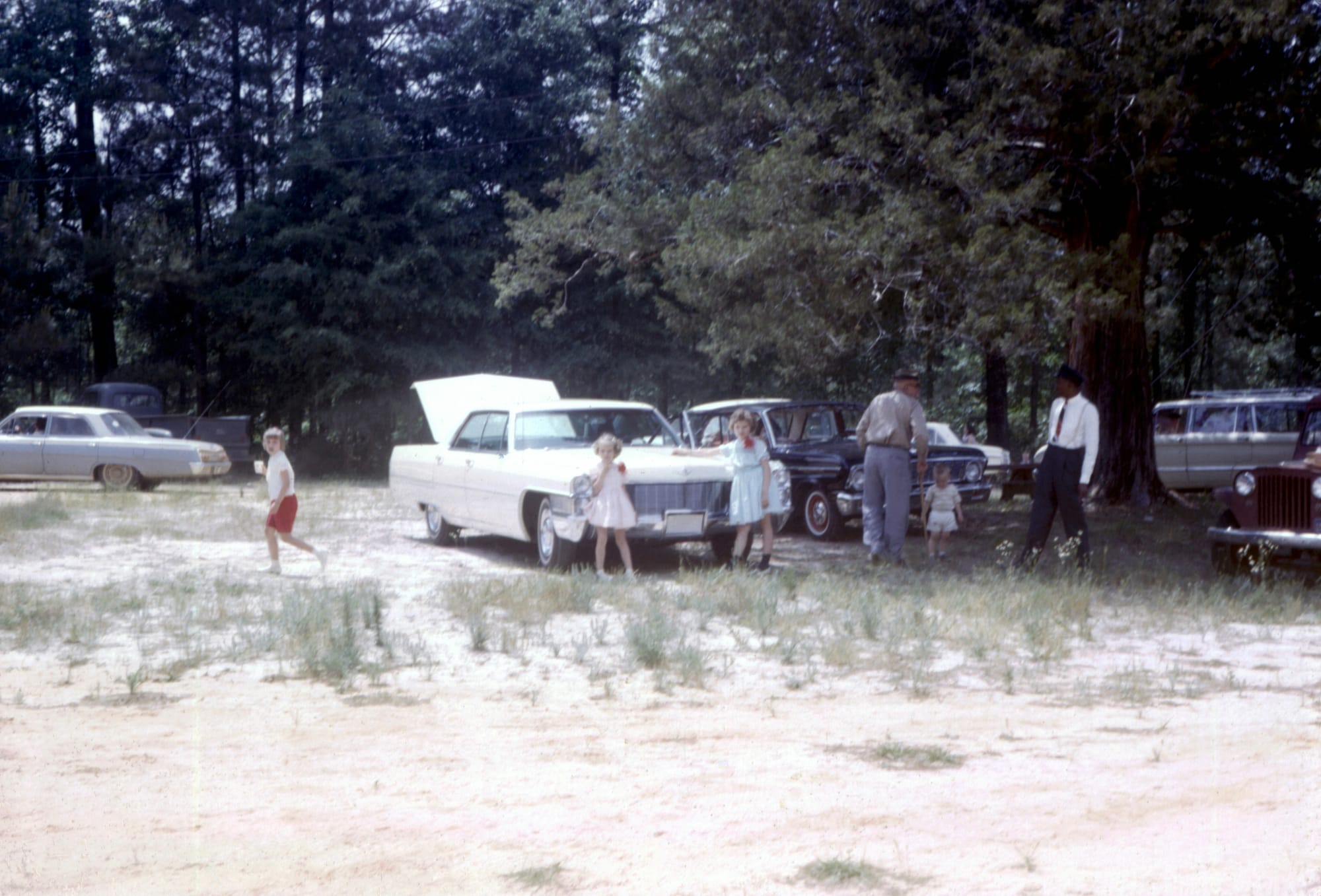
Aunt Angeline made her annual conspicuous appearance at the Lowery family reunions under the cedar-shaded yard of Pleasant Grove Baptist Church in the mid-1960s in a shiny white DeVille. She looked all the part of a well-to-do Mobile widow, in hat and gloves and chauffeured by a slender Black man in tie, suspenders and a cap.
Angeline died years before I was born, so the first I knew more of her than her name was when I digitized a box of old Kodachrome my last Christmas in college. She wasn’t my aunt, or even my great aunt, but my great-great aunt, or great-grandaunt as genealogists like to say. Everyone who was around still remembers her — her cars, her drivers, her dresses and her airs — yet none of them all that fondly.
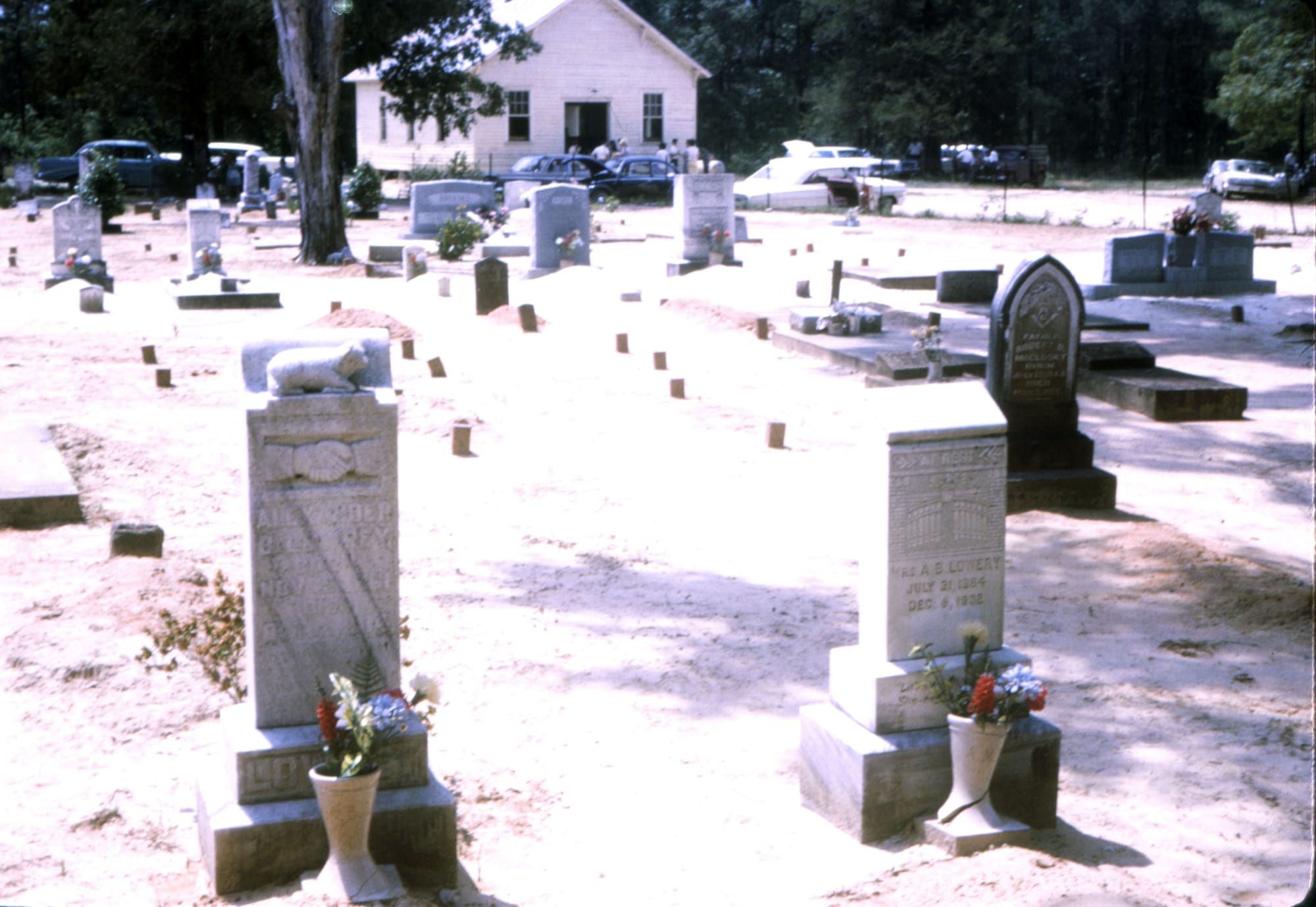
She is assumed responsible for the marble markers at the graves of her parents in the church's sandy graveyard, as they were gifts none of her siblings could have afforded. All agreed she was rich, but no one would say how. The whispered insinuations would survive her departure from the reunions — and from the earth.
I’ve never seen one family reunite quite so often, especially when so many of the attendees lived the rest of the year within 50 or so miles. It was at one of these reunions years later when my grandmother, before a dwindling audience gathered over cleaned Pyrex dishes, told a family rumor in her trademark matter-of-fact manner.
Somewhere in downtown Mobile, she wasn’t sure exactly where, Angeline’s husband operated a watch-repair shop. What everyone of my grandmother’s generation knew but seemingly never spoke of was that he rented space in the back of his shop to someone who provided abortions. My grandmother's ribs quickly found the end of her sister’s sharp elbow, according to a relative present for the reveal. That stifling shut off the flow of any further details, and as far as I know, she never mentioned it again.
As an avid rabbit-chaser, this family rumor triggered my nosy reporter senses. My grandmother was never a malicious gossip. She always came home from the beauty parlor with news of sorts but it was mostly about who had died or divorced or moved away, just typical background chatter to fill the gaps in more personal conversations. So this one was particularly memorable.
In the years since hearing of the secret, I’ve read countless deeds, wills, maps, city directories and newspaper clips in an effort to confirm or disclaim its veracity. It turns out the secret everyone hushed away might have been the least interesting secret of Angeline’s life.
Correction: A photo has been added to correct the writer's description of his great-great-grandparents' graves as obelisks. He regrets the error.
About Black Sheep: In this series I plan to share the stories of black sheep. My first subject is one whose every surprise begets a deeper mystery — none ever truly astonishing anyone in my family. She died years before I was born but her familial impact reached into my lifetime and early memory. This is the one space in which I'll entertain a limited number of rumors — and even then only to explore the evidence needed to confirm or dispel them. My intent is neither to vilify nor to praise, but to cast light on the story of someone long gone and, perhaps by her own design, forgotten. Documentation includes marriages, deeds, liens, trusts, wills, newspaper clippings, telephone and city directories and public maps. Anyone identified by name will be precluded embarrassment by generations of settled graves.