
Before the well runs dry
There are some places so embedded in your core memories, you can describe every nook and no-man's-land with your eyes closed. Some are so ingrained — very nearly genetically — that your confidence in that memory tempts no reach for supporting evidence.
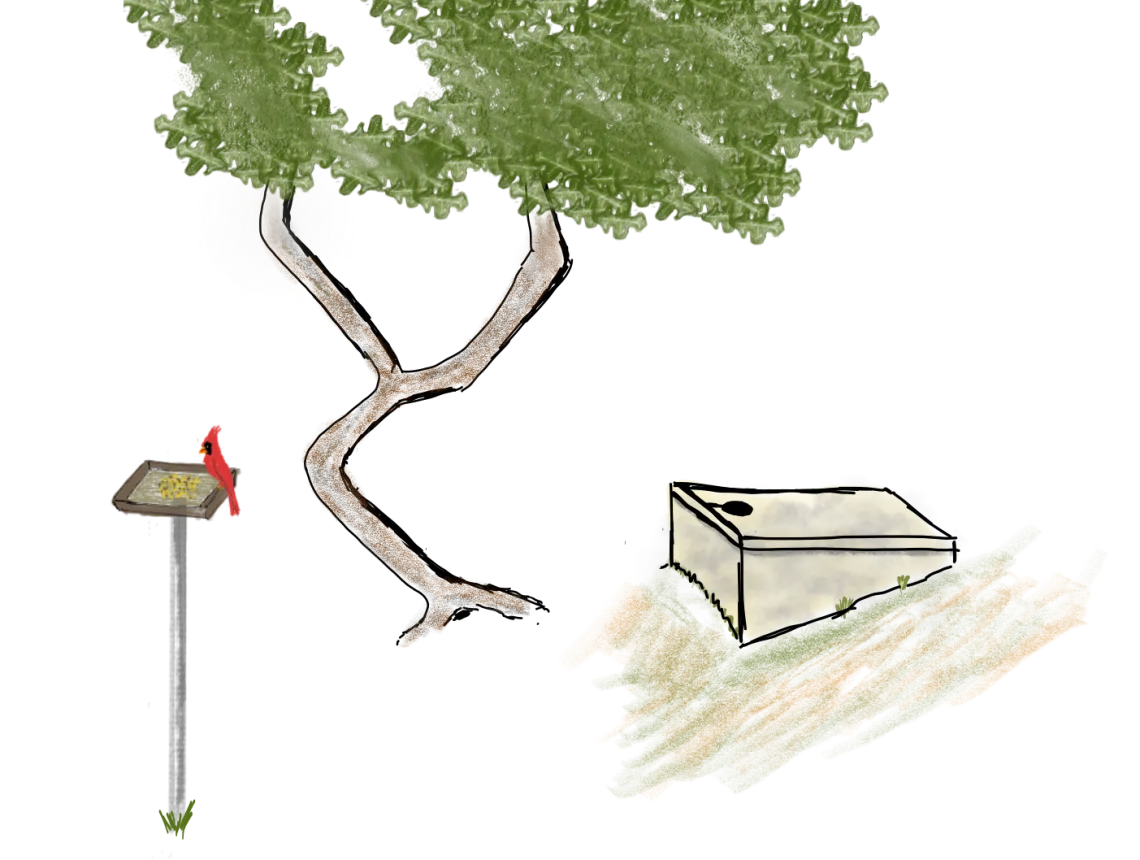
My grandfather lived on the McVay property off the four-lane north of town, across from the Vanity Fair sewing mill, amid a string of houses occupied at various times by his siblings. Afternoons at Paw's began with the indulgent chirps of redbirds at a loaded feeder, observed from the screen porch with his elder sisters over coffee or Cokes and updates on grandchildren. The birds' luncheon was served with deliberate timing, and any milling grandsons shooed inside, to prime the daily entertainment so its usual attendees would linger until Parkertown rush hour.
After picking the last of yesterday's cornbread, the cardinals slowly scattered, and the sisters shortly did the same. Their departure was gracefully — and mutually — timed to beat the rolling Doppler moan of log trucks carrying loads to the sawmills, eventually interrupted by the frenetic darts of sewing plant workers against after-school traffic.
At center stage stood one crooked and inviting tree.
It was a twisted post oak, bent in its adolescence against the weight of a larger, slowly decaying victim of a 1920s hurricane — at least according to the chin-scratched supposings of a couple of McVay men who'd educated their guess through their shared vocation surveying the woody acres of Clarke and surrounding counties. Along isolated property lines they retraced through cypress swamps, clay pits, piney ridges and pecan groves, these men decisively judged the fate of every boundary-straddling ash, poplar, or hickory blocking the view between transit and rod, making accommodations for the most regal offenders.
When clearing the lot for my grandfather Ralph's house, perhaps inspired by its winning spirit, he and my great-grandfather Blake spared this gnarly specimen as a strong contrast to the straight and statelier post oaks, sweet gums and, up by the highway, a handful of young pines — its visual interest rivaling that of a craftsman's yard ornament. Nearby they placed a concrete box cistern and dug an extension onto the family water system from the nearest sibling's house, tapping into spring water held atop a tower behind my great-grandfather's home three houses up Highway 5.
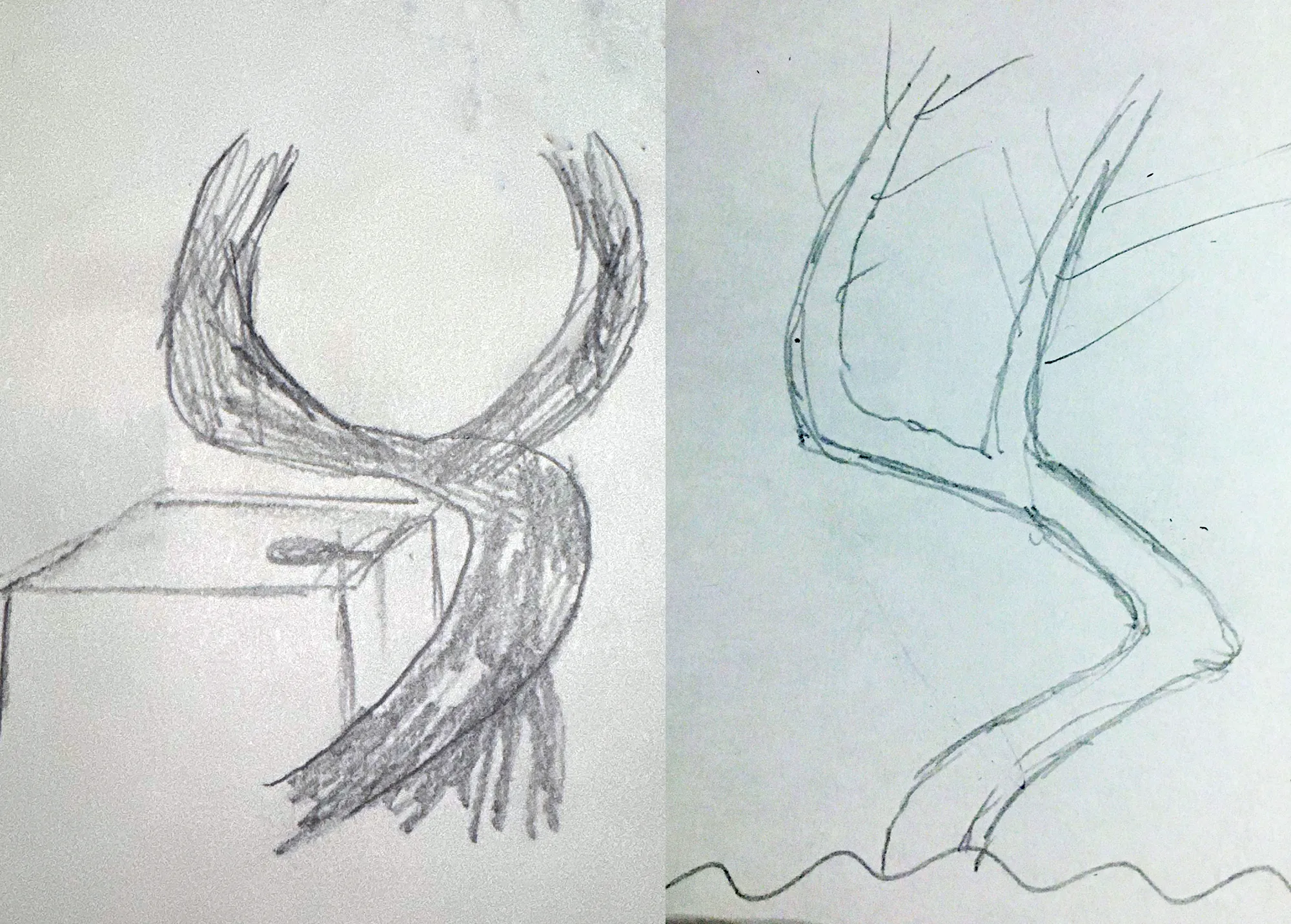
The oak's trunk emerged from the slope nearly horizontally just downhill from the cistern's corner, its roots twisted into a mound at its base, whose crevices formed a repository for rainwater and the seed pods of the backyard's mightier sweet-gums. Its own shade and South Alabama's regular rainfall tended a soft coating of green moss and gray-blue lichens. The oak's persistence as a sapling gave the trunk one distinctive bend westward, then a sharp turn back toward the highway, along which it split upward into two parallel branches. An eight- to ten-year-old could trot toward it and — in a twisted leap, one leg akimbo, mount the mossy trunk above the first bend. He could then steady himself erect, shinny out around the middle branch and to the end, press his back against the farthest vertical branch and walk his feet up the middle branch until he was nearly horizontal or even heels over head. When all the moss, lichens, and insects had been examined and a pinnacle reached, the concrete platform was adjacent for a proper dismount.
The cistern was out of commission by the time I deemed it my home base. If explored before afternoon coffee, a kid could lift the handle of a shallow cast-iron skillet from its surface to reveal a hole roughly the size of a plum — the only evidence any pump ever plumbed its depths. The hole summoned appropriate interest from a boy huddled over an abyss, the sunlight teasing glimmery hints at the cistern's contents.
Other methods were equally as indeterminate on the well's depth. The greatest hindrance to any authoritative measure of the cistern's unknown boundary owed to one of two causes: the already scarce light, or the murky surface of collected rainwater stealing the rest of it. Even the echo of dropped sweet-gum balls piercing the water's surface could deduce not depth but merely fullness. Nevertheless, a visit to the cistern was wasted without hearing that blip. Needing the sun at my back to gather focus, I was proportionately obstructed by my own shadow.
Any adult witness to this inevitable test of cognitive endurance would assess a child's intelligence by how quickly they abandoned the pursuit. However long it took me I can only hope no one observed.
Among my humblest discoveries was that, of my own head and the cistern's consuming curiosity, mine was the bigger thief of light. As I gave up and turned my back, the light and imagery tore away like a disrupted dream.
All I can do with that property now is to try to draw it.
I've never been much of an artist. A versatile southpaw, there are few things I can't do with my right hand: pick a guitar, shoot a rifle and write my name — and one I can't do with my left: throw a ball straight. I was certain from the frustrations of my early teachers and the comparative athletic prowess of my correctly handed brothers that nothing done with the left could be of good quality. The shame is no novel trauma — sinister derives from the Latin for left-handed, so these aspersions go back at a minimum to ancient Rome.
It's a genetic aberration I inherited from my father, whose grammar-school teachers contorted his writing stance into a hooked arm-drag from the right side of the page, which he carefully enhanced over manual drafting machines and mylar plats. A shift between our generations in the praxis concerning handwriting strained my hand in a different direction from my dad's — a persistent struggle among southpaws if only because no turn of paper or wrist, push or pull, can usurp control from the direction our brains read.
In my early years, I entered the church sanctuary every week with a telltale stain down the side of my hand, a remnant of the fresh tracks of washable markers I had repeatedly dragged my hand across while drawing an image from our Sunday school lesson, the subtractive property of pigment melding bright blues and oranges and greens into a deep, reflective black — at the newspapers where I'd later work, this quality is referred to as rich black. By contrast, the standard black ink designed for headlines and body copy appears flat and alien in an otherwise vibrant centerpiece, appearing sunken under the colors. Rich black floated on top with them. The men who bought the ink hated rich black.
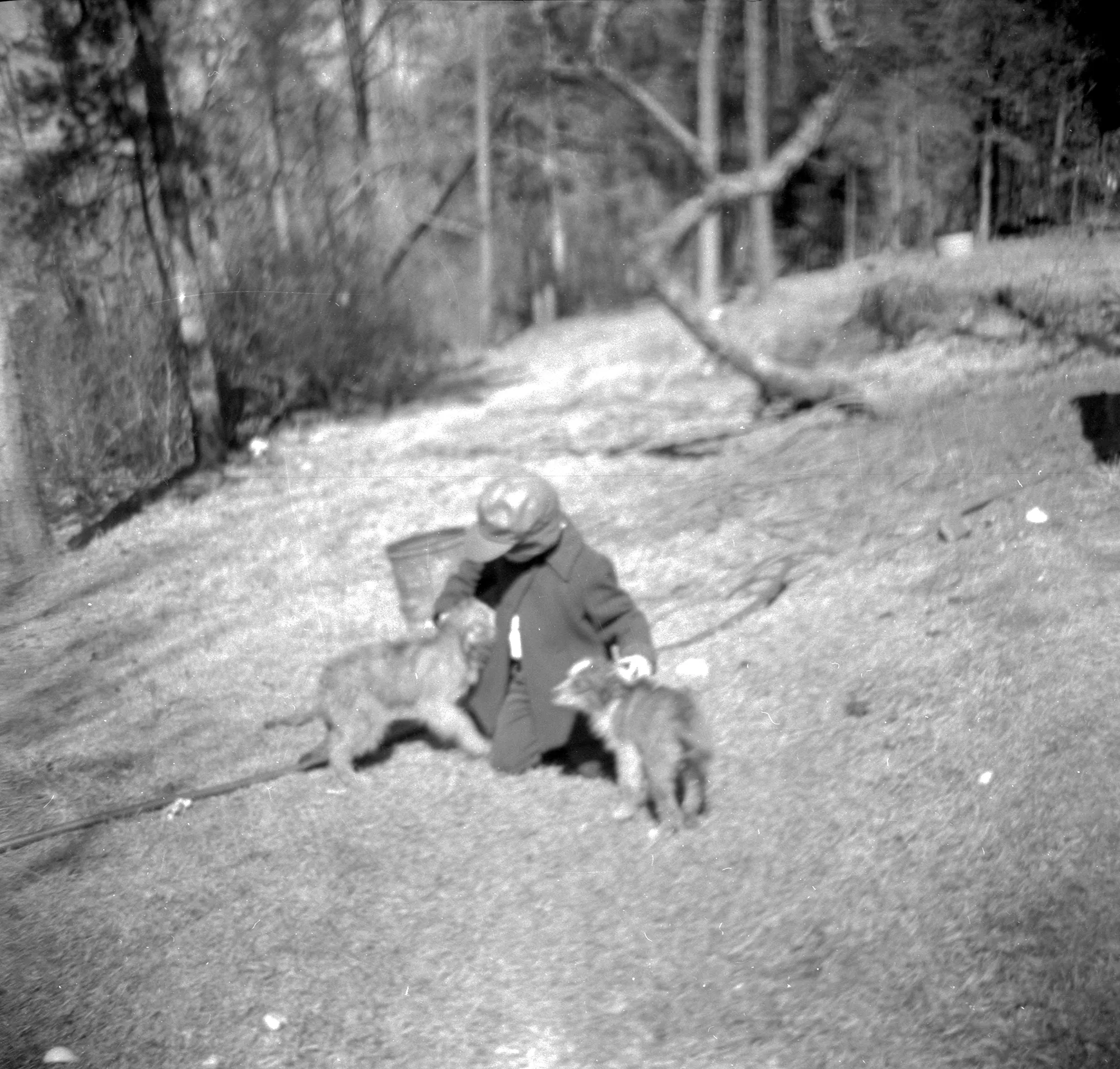
A text message from my dad tore me from my dreamy memory with this photographic evidence, betraying as foolhardy my confidence in that scene's specifics. The cistern isn't even in the frame. That's not close enough for me to jump from one to the other. I swore I remembered that acrobatic feat as firmly as I often recall roller-skating in a backward zig-zag — right into a wall of reality. The town skating rink's proprietor began every party until I was in second grade by tightening my wheels, and it wasn't to slow me down. I'd uncovered a sin my memory had committed — underestimating and even back-editing my clumsiness.
Memory is perhaps the greatest gaslighter you'll ever encounter. Inaccurate or imprecise spatial measurements, such as the distance between a tree and a concrete box, can leave enough space to insert false memories of actions. Mine is wont to insert memories of athleticism and agility, neither a quality I ever boasted or could even bluff.
This humble realization convinced me to manage illustrations with pixels and not paper, so I can reshape, resize, reposition as I gently correct my memory against the evidence.
I invite you to peer with me into the well.
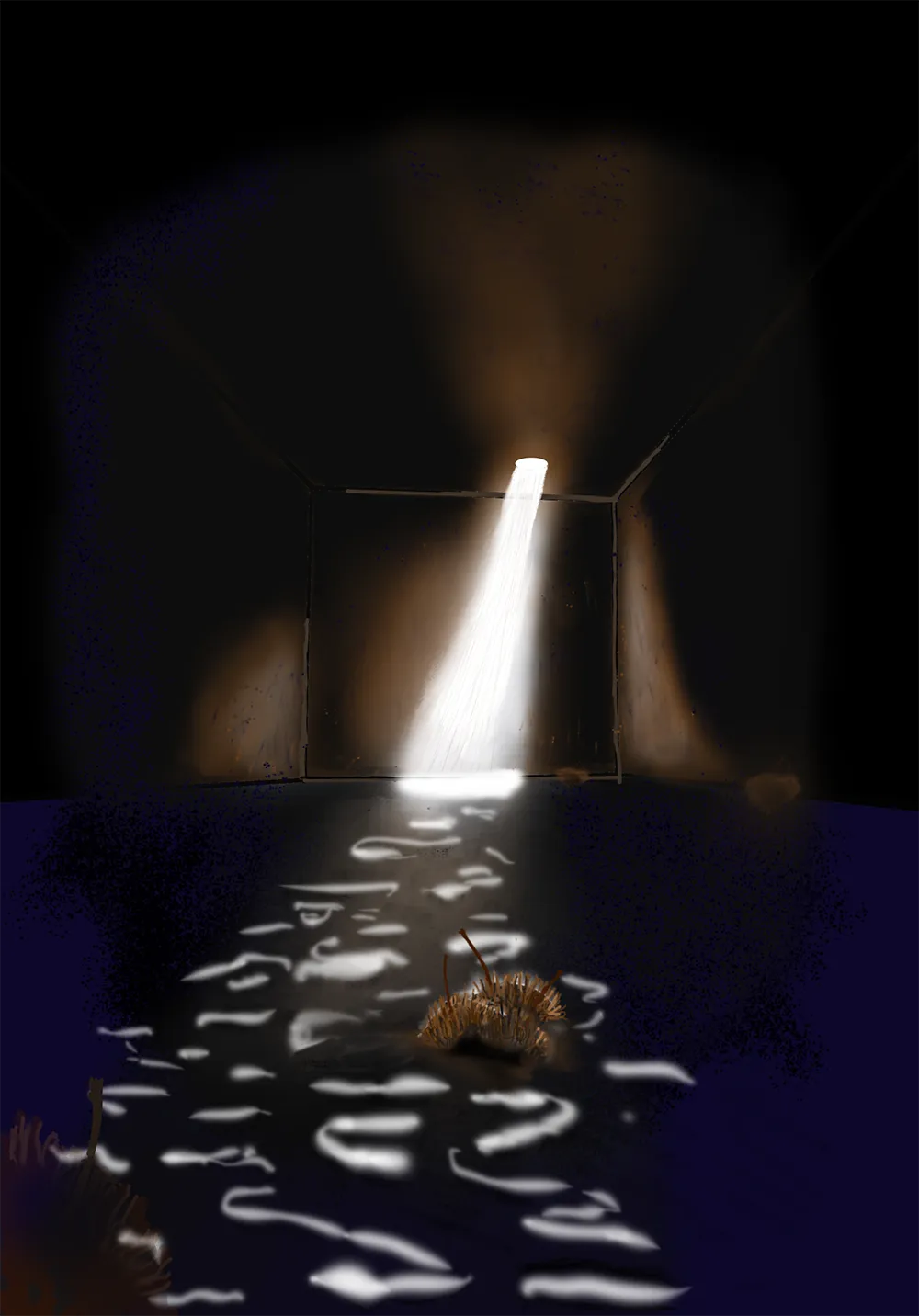
ABOUT THIS SERIES: This is a series in which I'll share a story connected to the McVays or their property. The posts might include photos but the main image for each will be a sketch in which I attempt to explore the area starting from the curvy post oak at Paw's and the concrete cistern at its base. Follow along as I share a few stories and attempt to form a clearer picture.